Network topology.
This section describes the AWS Network Topology.
Regions
A region is a physical geographical location (like Amsterdam or Sydney) where AWS clusters multiple, isolated data centers. Think of it as a city where your cloud resources live. Its purpose is to provide a place to host your resources close to your users for lower latency, and help meet data residency/compliance requirements.
Virtual Private Cloud
Each customer has their own infrastructure isolated from the rest. This is made possible by the use of a VPC. A Virtual Private Cloud is akin to your own private network in the cloud. It provides your own isolated section of the internet with your own IP addresses that you can define and use. It provides security and control over your network environment, allowing you to route tables, network gateways, and access rules. VPCs are confined to a single AWS region, meaning all your AWS resources must be launched within a VPC.
Availability Zones
Having one data center per region serving a large population is risky and impractical. As a result, AWS came up with Availability Zones (AZ). These are separate data centers within the same region. They ensure high availability and fault tolerance. If there’s a power outage in one AZ of the zone Users can still use their resources in other zones, which are located in other parts of the region.
Subnets
Within a VPC, your own private isolated network, you have a range of IP addresses that you can use? Well, Subnets are smaller network segments within your VPC. Each has its own IP range. You can configure how these small segments are accessed.
Conclusion
Combining all above concepts we eventually have
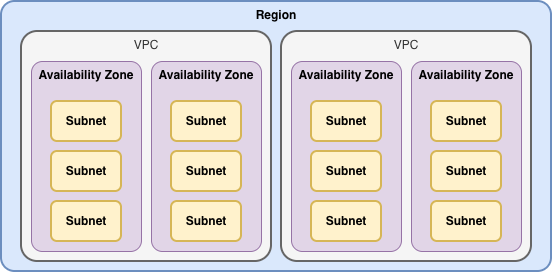
- Regions are physical locations where AWS has data centers.
- A Virtual Private Cloud (VPC) is your private network in the cloud.
- Availability Zones are separate data centers within a region.
- Subnets are smaller network segments within your VPC.